-->
From the Archives: A Gold Box for Rouge & Patches, 1783
View Detail

From the Archives: A Gold Box for Rouge & Patches, 1783

Isabella reporting:

An 18th c. French lady could take literally hours dressing for an important ball. Just like modern celebrities preparing for the red carpet, a Parisian court beauty required a team of experts to dress and powder her hair, apply her make-up and patches, fasten jewels around her throat and wrists, lace her into her stays, and pin and her into her gown.

But even this carefully crafted magnificence might need a touch-up or two in the course of the evening, and a lady had to be prepared. This little gold box, left, contained a looking glass, a tiny brush, rouge, patches - those black velvet faux beauty marks so well-loved in the 17th-18th centuries.

Just as fashionable artifice reached new heights in the 18th c., so, too, did the craftsmanship that produced this box. This is the work of a master goldsmith: precisely cut and meticulously soldered, with inset hinges and perfectly fitted panels as well as separate compartments for the rouge and patches. The surfaces of the box are beautifully decorated as well in contrasting yellow and white gold. All of this is done on a miniature scale: the box measures only 2-1/8" x 1-1/2" x 5/8".

It's easy to imagine a lady using such a piece for artful flirtation, gracefully opening the little box and fluffing the brush over her cheeks, and, perhaps, coyly using its gleaming reflection to check the interest of the gentleman sitting behind her....

Above left: Box for Rouge and Patches, French (Paris), 1783-84, Varicolored gold. Metropolitan Museum of Art, Bequest of Kate Read Blacque. Photos copyright Susan Holloway Scott.
Lower right: Les Adieux, engraving, Jean-Michel Moreau le Jeune, 1777.
A Beautiful Bed with (Perhaps) a Political Agenda, c.1805
View Detail

A Beautiful Bed with (Perhaps) a Political Agenda, c.1805

Isabella reporting,

Loretta has shared many examples (such as these here and here) of furnishings from the pages of Ackermann's Repository, showing what was "on trend" for fashionable homes in early 19thc Great Britain.

I was reminded of those illustrations when I recently spotted the bed, left, in the Metropolitan Museum of Art. With its swooping curves, gleaming mahogany, ebony, and rosewood, brass inlay, and elaborate (reproduction) hangings, the bed could have been straight from the pages of Ackermann's. There's one difference, however. It wasn't made in London, but in New York.

According to the bed's placard:

"Following the Revolution, Americans took inspiration from the ancient empires of Greece and Rome in the establishment of a democratic republic. In turn, domestic interiors and furnishings began to resemble architecture and artifacts from classical antiquity. This bed's sweeping frame echoes the form of a Roman lectus (daybed) and the bronze plaque at the base bears the profile of a Roman magistrate or military officer."

In other words, this bed wasn't just a stylish piece of furniture: it was making a patriotic statement. Eagles and stars appear throughout American design of the period, and combined with the ancient Roman design, this bed was a thorough expression of Federalist sensibilities.

Or perhaps not. Although it was made in New York, the maker was a Frenchman, Charles-Honor� Lannuier. One of the city's foremost furniture makers, Lannuier employed his Parisian cousin, Jean-Charles Cochois, around the time this bed was made. Cochois would have brought with him the latest in Parisian designs inspired by the newly-created French Empire of Napoleon Bonaparte. Napoleon, too, wanted to create a new country with all the trappings of ancient Rome, but of a Roman empire rather than a Roman republic. So are the aggressive eagles on this bed republican American eagles, or imperial French ones?

One more thought: to the early 19thc customer commissioning this bed, the political and bellicose overtones of its design would have been a selling point. Today's consumers, however, prefer their beds to be a bit less menacing. While this style of classically-inspired bed - without the eagles and inlay - is once again very popular, savvy modern manufacturers call them sleigh beds - conjuring up cozy images of fresh snow, warm blankets, and sleigh bells instead of stern Roman military officers plotting their next conquest.

Above: Bedstead, by Charles-Honor� Lannuier and Jean-Charles Cochois, c.1805-8. Metropolitan Museum of Art. 
Photographs �2016 Susan Holloway Scott.
Embroidery for a Man's Suit that Was Never Made Up, c1780
View Detail

Embroidery for a Man's Suit that Was Never Made Up, c1780

Isabella reported,

Last month I visited the Metropolitan Museum of Art's Antonio Ratti Textile Center and Reference Library to study examples of 18thc embroidery (see my first post here), including this fascinating example. As always, please click on the images to enlarge them.

This piece is really several pieces, or panels, featuring the embroidered elements for a man's suit that was never completed. Elaborate embroidery was the height of male fashion in the 18thc, and skilled embroiderers executed designs in silk, sequins, and beading.

The embroidery was worked flat, with the fabric stretched taut on wooden frames. The embroidery pattern and the garment's outline were transferred to the fabric via pouncing - a light chalky powder pressed through tiny holes in the paper pattern - and then the lines were reinforced with ink on the fabric. These lines were meant to be covered by the embroidery, although some do still peek through if you look carefully.  The illustration from Diderot's Encyclop�die, upper right, shows two embroiderers at work on a coat.

These panels are embroidered in silk thread, with accents of netting, on a purple silk cloth. The larger panel, left, includes not only the embroidery for accenting the front of the coat, but also the pocket flaps, upper left, and buttons, bottom left. The second panel, lower right, has the collar and cuffs as well as the knee tabs for the matching breeches. (To better understand how all these puzzle-pieces were meant to be assembled, see this similar suit, also in the Met's collection.) The pieces that are basted together in the second panel may indicate that different embroiderers were working on the same project.

In most cases, the completed embroidered panels would have next gone to a tailor to be made up into a suit. The embroidery could have been ordered to the tastes of a specific customer, or done on speculation. Either way, it would have been the tailor's responsibility to assemble the embroidery to fit his customer's body.

These panels were never made into finished garments, and the reasons why are now forgotten. They're rare survivors of the historic fashion trades, and wonderful to study as they are. But being a fiction writer, however, I kept wondering why the suit was never made. Were the colors of the silk flowers not to a customer's tastes? Was the embroidery more expensive than he expected, and never claimed? Or was the embroidery somehow "so last year," and out of fashion before it could be finished?


Many thanks to Melinda Watt, Associate Curator, European Sculpture & Decorate Arts, and Supervising Curator, Antonio Ratti Textile Center, and the staff of the Antonio Ratti Textile Center for their assistance, knowledge, and patience - as you can tell, I had a wonderful Nerdy-History-Girl time!

Above: Embroidered panels for a man's suit, French, c1780, Metropolitan Museum of Art. Photographs �2016 by Susan Holloway Scott.
A Close Encounter with Silk Embroidery for an 18thc Gentleman's Suit
View Detail

A Close Encounter with Silk Embroidery for an 18thc Gentleman's Suit

Isabella reporting,

One of my favorite textile/costume exhibitions was last summer's Elaborate Embroidery: Fabrics for Menswear before 1815 at the Metropolitan Museum of Art (you can read my post about it here.)

But as wonderful as the exhibition was, I longed to see the richly embroidered samples more closely than the display cases permitted. Last week, I finally returned to the Met for a research appointment at the Antonio Ratti Textile Center and Reference Library - the keepers of all those embroidery samples and much, much more besides.

The sample here (click on the images to enlarge) was one of the ones that I requested to view. It's not large: 12-1/2" x 7-3/4". The black fabric is faintly dotted silk velvet, and the embroidery threads are silk and metallic. There are also dozens of tiny sequins as well as paste jewels worked into the design. It might have been a sample of an embroidery pattern that was shown to gentlemen considering new suits, or it could also have been a experiment with a new pattern. The sample eventually became part of the textile design archives of The United Piece Dye Works, who gave the collection to the museum in 1936.

This sample was stitched in France around 1800-1815, long past the time when Louis XVI's court and their legendary excess had been displaced by the Revolution. But Napoleon Bonaparte liked those same sartorial trappings as much as his royal predecessors had, and gentlemen appearing at the imperial court were expected to appear in suits of luxurious fabrics embellished with embroidery like this. Of course, this kind of elaborate formal dress had never stopped being worn at the English court and others like it across Europe, but these suits were to be the last gasp of the glittering male peacock. Within a generation, formal wear for gentleman became dark and subdued, and has remained so to the present day.

Worked in shades of silver with gold accents on that inky velvet, a suit enhanced with the design in this sample would have sparkled and gleamed in an elegant, refined show of wealth and taste. Equipped with a magnifying glass, I was able to see the exquisite delicacy of the stitches, and the extremely fine silk and metallic threads used to create them, threads that would likely be impossible to find today.

I was especially interested in the tiny sequins, held in place by even smaller beads. The sequins that were stitched directly onto the velvet had tarnished over time, probably from a dye in the velvet, giving them an unintentional ombre effect. The small paste (glass) "jewels" near the edge were secured in in metal collars, which in turn were hidden by a loop of wrapped metallic thread. These details are visible where some of the loops has slipped away from the jewel.

I also loved being able to see the back side of the embroidery. Without the pile of the velvet and the glitter of the sequins and jewels, the design becomes more linear with the transition stitches criss-crossing over the flowers and leaves. In a way, it's equally beautiful, like the finest of silk spiderwebs.

Most of all, seeing this sample in such detail left me in awe of those now-forgotten designers, embroiderers, thread-spinners, sequin-and paste-jewel makers, velvet-weavers, and needle-makers who would have each contributed to its creation, and the skill, artistry, and accomplishment that this small bit of two-hundred-year-old fabric represents.

Many thanks to Melinda Watt, Associate Curator, European Sculpture & Decorate Arts, and Supervising Curator, Antonio Ratti Textile Center, and the staff of the Antonio Ratti Textile Center for their assistance, knowledge, and patience - as you can tell, I had a wonderful Nerdy-History-Girl time!

Above: Embroidery sample for a man's suit, French, 1800-1815, Metropolitan Museum of Art.
Photographs �2016 by Susan Holloway Scott.
Portraits that Stayed Fashionable, c1775
View Detail

Portraits that Stayed Fashionable, c1775

Isabella reporting,

When I saw this portrait, above left, last month at the Metropolitan Museum of Art, I was puzzled by the lady's hair. Here on the blog, we're no strangers to 18thc Big Hair (see here and here), but the exaggerated styles don't come into fashion until the mid-1770s, and this woman's dress with the wealth of bows is firmly around 1760, which is where the museum places it, too.

So how did she manage to be so fashion-forward for her portrait? Turns out it's a case of 18thc celebrity Photoshop. Marie Rinteau and her sister Genevi�ve were celebrated beauties who, according the museum's notes, converted fleeting musical careers into the more profitable ones as "cultured courtesans known as les demoiselles de Verri�res." Marie was the mistress of soldier and courtier Maurice de Saxe, and bore him an illegitimate daughter, Marie Aurore.

In 1761, the two sisters had their portraits painted by Fran�ois Hubert Drouais (1727-1775), an artist who specialized in beautiful portraits of beautiful women; among his sitters was Louis XV's mistress Madame du Pompadour. The sisters were painted in rich settings, wearing lavish silk gowns with costly lace. To indicate their musical talents, Marie is holding sheet music, while Genevi�ve is shown gracefully playing her harp. They were also originally painted with the hairstyles of 1760, which were tightly curled and close to the head, much like another lady that Drouais painted around the same time, below left.

Fifteen years later, however, the demoiselles decided that their portraits needed to be updated. Either Drouais or another artist added the latest hairstyles sweeping upwards from their foreheads and decorated with plumes and festoons of silk flowers and faux pearls. Yet like the infamous portrait of Dorian Grey, their painted faces remained unlined and youthful.

Marie died in 1775, aged around forty-five. Perhaps this refurbishing was a final small vanity before her death, or perhaps it was her way of stalling the inevitable in a "career" that would have become increasingly difficult to maintain as the years passed. Either way, I'm sure she'd be pleased that her portrait is now admired by hundreds of visitors a day in one of the greatest museums in the world - and her hair is perfect.

Extra: One of our friends of the blog, art historian Kimberly Chrisman-Campbell, recently published an article about other 18thc portraits that were altered to update them. You can read it here in the magazine of the Huntingdon Library; search for Hair Today, Gone Tomorrow to go directly to the article in the issue's pdf.

Above left: Detail, Marie Rinteau, called Mademoiselle de Verri�res, by Fran�ois Hubert Drouais, 1761, Metropolitan Museum of Art.
Right: Genevi�ve Rinteau de Verri�res by Fran�ois Hubert Drouais, 1761, private collection.
 Bottom left: Detail, Countess Darya Petrovna Saltykova, by Fran�ois Hubert Drouais, c1760.
What's Old is New: Double Rings
View Detail

What's Old is New: Double Rings

Isabella reporting,

Among the hottest trends in jewelry right now are double rings - rings whose designs span two fingers. It's considered a look that's new, hot, fresh, and very 2016.

So even though I know that there's nothing new under the sun, I was surprised when I saw this ring, upper left, last week at the Metropolitan Museum of Art. The shadow reveals the two rings beneath the three stones, and the black-and-white photo, right, from the museum's web site shows the joined rings more clearly.

Featuring an emerald flanked by two rose-cut diamonds set in gold, the double ring was made in New York in 1895 by the well-regarded jewelry firm of Marcus & Company. The company's founder, Herman Marcus (1828-1899), was known for taking inspiration from the past for his designs, and this ring is in the Renaissance revival style popular at the time. So very 1895, by way of the 16th century.

But it turns out that the design is even older than that. A little more investigation, and I learned that the double ring design dates back at least to the 1st century BC, when the ring, lower right, was made in Hellenistic Greece. With an amethyst flanked by two garnets set in twisted bezels, this gold ring would be right in style today. Proving that, once again, what's old (even very old!) is new again.

Above: Double ring, Marcus and Company, 1895, Metropolitan Museum of Art. Top left photography �2016 Susan Holloway Scott.
Below: Hellenistic Greek gold double ring, 2nd-1st century. Private collection; image via TimeLine Auctions.
An Artist in Revolutionary France: �lisabeth Vig�e Le Brun (1755-1842)
View Detail

An Artist in Revolutionary France: �lisabeth Vig�e Le Brun (1755-1842)

Isabella reporting,

Last week I saw a wonderful show of 18thc portraits at the Metropolitan Museum of Art, an exhibition devoted to the work of a single, highly successful artist. Such an exhibition would be common enough if the artist were Sir Joshua Reynolds, Thomas Gainsborough, Jean-Honor� Fragonard, or any of the other prominent male painters of the era. But what made this exhibition unusual was that the featured artist was a woman - �lisabeth Vig�e Le Brun � and that despite her talent and success, this is the first retrospective of her work in modern times.

Vig�e Le Brun: An Artist in Revolutionary France (on view now through May 15, 2016) includes more than 75 of the artist's works. Included are the portraits that made her one of the most important artists of her time. Born into a family of artists, she was painting professionally as a teenager; only her marriage at twenty-one in 1776 to the leading art dealer in Paris kept her from being accepted into the Acad�mie Royale de Peinture et de Sculpture.

However, Mme. Vig�e Le Brun's work had already attracted the attention of Queen Marie Antoinette. She painted her first official portrait of the queen in 1778, and as court painter, she went on to paint more than thirty more of Marie Antoinette and the royal family. With the queen's patronage - and pressure - Mme. Vig�e Le Brun was finally admitted to the Acad�mie in 1783, where she was one of only four women members. Her portraits became in great demand at the French court, and she painted both celebrated beauties and powerful nobles.

But as revolution loomed, the queen's patronage proved more of a danger than a benefit. To avoid arrest, Mme. Vig�e Le Brun fled France with her young daughter Julie (she had separated from her husband) in 1789, and took her talents to other cities and royal courts across Europe. It was a perilous time for travel, especially for a woman, yet Mme. Vig�e Le Brun's commissions led her to Florence, Naples, Vienna, Berlin, London, and St. Petersburg. As the political climate again changed in Paris, she was finally permitted to return to France during the reign of Napoleon I. Although her style gradually fell from artistic fashion, she continued painting until her death in Paris in 1842.

Her memoirs, first published in 1835, are often quoted in the captions of the Met's exhibition. Not only do they reveal her talent for maneuvering through the Parisian art world, but also show an equally important skill for a portraitist: the ability always to find something favorable to say about her sitters.

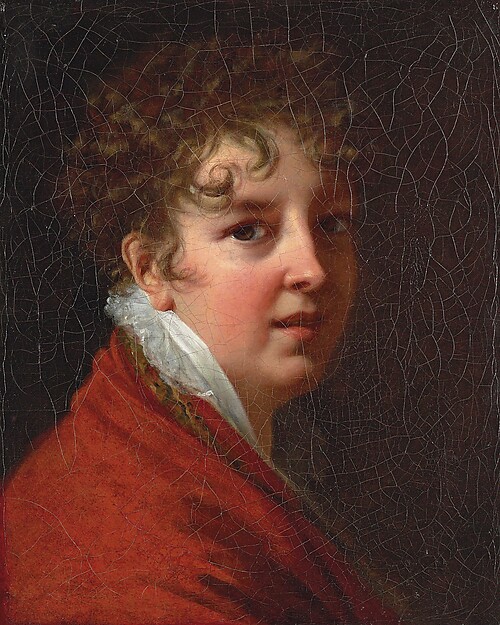
Her sensitivity and sympathy show in her portraits, and it's much of what makes them still so appealing today. I've chosen to illustrate this post with a selection of Mme. Vig�e Le Brun's self-portraits, and she presents herself not only as an attractive, successful woman, but also as an approachable and charming one, her lips always slightly parted in a smile. Sitting for her must have been a pleasure in every sense.

While I know most of you won't be able to travel to New York to see the exhibition in person (and I share your pain every time I hear of a must-see show in London or Los Angeles!), the Met has generously put all eighty works on line here.

Above left: Self-Portrait with Cerise Ribbons by �lisabeth Vig�e Le Brun, c1782, Kimbell Art Museum.

Right: Self-Portrait by �lisabeth Vig�e Le Brun, 1790, Gallerie degli Uffizi.

Lower left: Self-Portrait by �lisabeth Vig�e Le Brun, c1808, private collection
Friday Video: Unfolding an 18thc Gaming Table
View Detail

Friday Video: Unfolding an 18thc Gaming Table


Isabella reporting,

For most of us today, furniture doesn't get much more complicated than assembling an Ikea bookcase. But for the cabinetmakers of 18thc Europe, furniture became the highest expression of art, engineering, and ingenuity combined. This gaming table was created by the famed German cabinetmaker David Roentgen (1743-1807) for a wealthy client; furniture like this was prized by the elite classes of the Age of Enlightenment. Featured in this video from the Metropolitan Museum of Art, this gaming table was not only an exquisite piece of art with beautifully carved and inlaid wood, but also a cleverly adaptable and useful piece of furniture.

If you received this post via email, you may be seeing an empty space or black box where the video should be. Please click here to view the video.
Samuel Pepys Checks His Smartphone...er, Watch, 1665
View Detail

Samuel Pepys Checks His Smartphone...er, Watch, 1665

Isabella reporting,

Recently I shared an 18thc painting of several fashionable folk consulting a pocket-watch with much the same intensity that people (fashionable and otherwise) stare at their iPhones and Androids. Turns out that this fascination with the newest technology is even older, and English diarist, administrator, and politician Samuel Pepys (1633-1703), left, was equally addicted in the 1660s.

Here's a quote from his diary from May, 1665, discussing his watch:

"The the 'Change [the shopping mall of Restoration London] and thence to my watchmaker, where he has put [my watch] in order, and a good and brave piece it is, and he tells me worth �14, which is  greater. . . than I valued it....So home and late at my office. But, Lord! to see how much of my old folly and childishnesse hangs upon me still that I cannot forbear carrying my watch in my hand in the coach all this afternoon, and seeing what o'clock it is one hundred times, and am apt to think with myself, how could I be so long without one; though I remember since, I had one, and found it a trouble, and resolved to carry one no more about me while I lived."

So even though all that Pepys's watch could to was tell the hour, he still couldn't help but check it repeatedly - and ostentatiously - throughout the day in a very smartphone manner.  Unlike the ubiquitous smartphone, however, a watch was still a gentleman's costly status-piece, something that very few ordinary Englishmen would have possessed at the time. Pepys proudly states that his watchman valued his watch at �14. To put this in perspective, the average English laborer in 1670 was earning approximately �13 a year.

It's impossible to know exactly what Pepys' watch looked like, but it was probably similar to the watch shown here, right. Made in London about 1640 by master watchmaker Edward East, it features outer and inner cases of silver and a movement of silver, steel, and gilded brass, with an elegant openwork floral design, lower left.

Note that the watch has only a single hand, for marking the hour. The second, minute hand didn't come into use until later in the 17thc, when the accuracy of watches had increased sufficiently to merit it. This watch could have run as long as sixteen hours from a single winding, although in the course of that time, it could also be as much as several hours wrong. But for its day, it was a marvel. Just ask Samuel Pepys.

Top left: "Samuel Pepys" by J. Hayls, 1666, National Portrait Gallery, London.
Lower right: Watch, made by Edward East, c1640, London. Metropolitan Museum of Art.
From the Archives: A Fabulous Gift to Readers from the Metropolitan Museum of Art
View Detail

From the Archives: A Fabulous Gift to Readers from the Metropolitan Museum of Art

Isabella reporting:

This post first appeared nearly four years ago, but that "fabulous gift" from one of the world's greatest art museums is still available, and it's an offer well worth exploring again for new treasures. Happy hunting!

It's a long time until Christmas, but the Metropolitan Museum of Art is playing the part of Santa and giving all us Nerdy History Folks the presents early. Dozens of digital versions of the Met's out-of-print exhibition catalogues and art books are now available online for FREE.

Yes, the price that can't be beat: free. Available both as Google books to read online or as higher-quality PDFs to be downloaded, these older titles are often impossible to find as books.  The digital versions aren't streamlined, either. All the original text, reproductions, and illustrations are included. Nor are these out-dated or irrelevant tomes; many of these books have permanent places on our Nerdy History Girls bookshelves.

Because the Met has such a vast and varied collection, the available books are equally diverse, ranging from ancient sculpture to medieval armor, Victorian furniture to modern musical instruments, portraits to tapestries. I can't begin to list them all here (here's the link to the search page), but I will recommend several favorite books that I own, wonderful, gloriously illustrated books produced by the Met's Costume Institute.

The striped taffeta robe � l'anglaise, top left, (French, c. 1785) is featured in The Age of Napoleon: Costume from Revolution to Empire, 1789-1815. French fashion changed dramatically in this time period, from the elaborate styles set by Queen Marie-Antoinette to the classically inspired elegance of Empress Josephine. There are also chapters devoted to jewels, military uniforms, court attire, and the influence of French fashion on American women.

The white cotton mull summer dress, right, might have been worn by an American Gibson Girl c. 1902-1904. It's to be found in Our New Clothes: Acquisitions of the 1990s. This collection ranges from a court lady's late 17th c. silk mantua to a man's red velvet suit designed by Tom Ford for Gucci in the 1990s. Also included are explanations of what made each garment a specially prized addition to the Met's collection.

The tableau of 18th c. French gowns, lower left, is from my all-time favorite costume book, Dangerous Liaisons: Fashion and Furniture in the Eighteenth Century. This book is the catalogue to one of the most ravishing costume exhibitions ever mounted at the Met. The specially-created mannequins were posed not in display cases, but in the Museum's period rooms, almost like actors and actresses in some exquisite 18th c. drama. I love how the relationship between the ornate furnishings and the clothes is so effortlessly shown, and how the mannequins are beautifully "styled", with the appropriate jewelry, shoes, plumes, fans, and hair. It's a gorgeous, fanciful book, and one that's been highly prized (and priced!) on the used book market, and I'm so glad it's now available here.